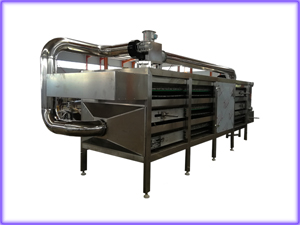
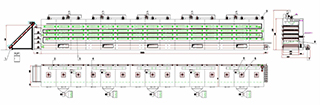
Multi-layer Mesh Belt Hot Air Drying is an important method for the agricultural products preservation with large processing capacity and investment saving.
1. New design for through circulation mesh-belt drying to get uniform air hot velocity & high efficiency drying rate
2. Hot air is circulation and the temperature is adjustable in accordance with the different drying section. Also, drying time is controlled and adjusted following to final dryness request.
3. The blower takes the fresh air after heat exchanger with max 140 oC into the bottom layer and moist air moist air is exhausted by the exhauster fan on the top, keep safety and workshop cleaning.
4. Hot air only entrance the bottom mesh-belt layer to pass through the material with temperature adjustable and high impacting velocity, Hot air only entrance the bottom mesh-belt layer to pass through the material with temperature adjustable and high impacting velocity, the exiting hot air goes to the other layer for drying continually, so energy saving is available. The whole drying process with stably and high effect will be finished.
5. According to the variety and processing capacity of agricultural products, 3 or 5 layers mesh belt drying are option to achieve upper layer feeding and lower layer discharging.
6. Steam heating is recommended, also, electric heating is available.
Multi-layer Mesh Belt Hot Air Dryer Technical Data for a 1500Kg/h Seaweed Drying
The heat pump drying system is divided into three types according to the structure type, that is, closed loop type, half open type, and open type. The so-called closed or open type refers to whether the air circuit is open.
The single-stage vapor compression heat pump dryer applies with high coefficient of performance (COP) and specific moisture extraction ratio (SMER) for medium-temperature drying.
Moisture fresh figs is more than 70%, it is not easy to preserve.
Unique drying chamber with no dead angle air circulation design is to ensure figs heated evenly, all figs at the same time to be drying process, improving the quality of figs of full shape, dry thoroughly, safe and hygienic, greatly extend the shelf life of figs